

Safety standards
No competitive result, commercial obligation, broadcast schedule or other consideration overrides the duty to protect pilots, operators, officials, spectators and the public. Everyone operating under IACSF authority is obliged to halt or suspend operations whenever a genuine safety risk is identified.
- Standards
- IACSF-STD-002
- Manual
- IACSF-MAN-001
- Maintained by
- Safety and Compliance Committee
- Review
- Annual, before each season
The Safety Officer's authority
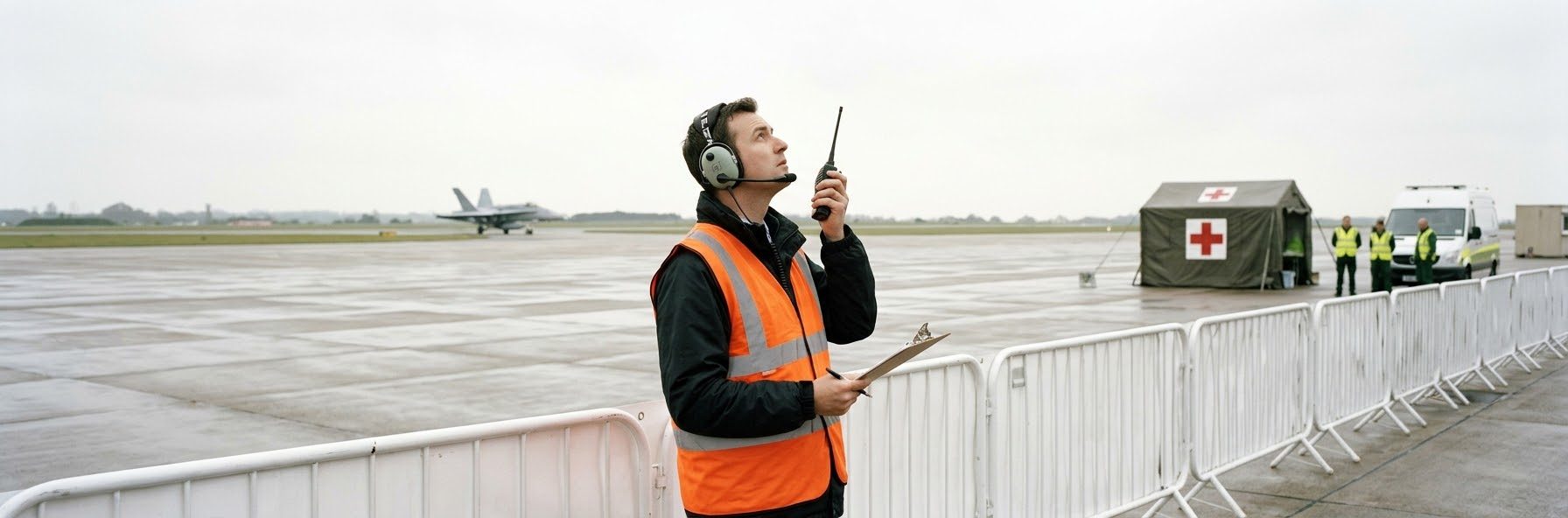
The IACSF Safety Officer deployed to a sanctioned event holds independent authority to order the suspension or cessation of any activity posing an unacceptable risk. That authority supersedes any instruction from event organizers, sponsors or competition officials, and no adverse action may be taken against a Safety Officer for exercising it in good faith.
At each event the Event Safety Officer may halt any competitive activity, remove any aircraft, pilot, crew member or official, impose operational restrictions beyond the competition program, require re-inspection of any aircraft, and withdraw a pilot showing observable signs of impairment. Safety decisions of the Safety Officer are final and not subject to competitive protest.
The Safety Officer must hold IACSF Safety Officer certification or a recognised equivalent, have no concurrent role as competitor, team official or judge at the event, be physically on site for the entire event including practice and inspection days, and have completed the current season's IACSF Safety Briefing.
Hierarchy of control
The Federation takes a proactive, risk-based approach: identify, assess and mitigate hazards before they cause harm. Organizers apply controls in this order of preference.
Elimination
Remove the hazard entirely.
Substitution
Replace with a less hazardous alternative.
Engineering controls
Physical barriers, combat zone design, aircraft system requirements.
Administrative controls
Procedures, briefings, certifications, scheduling.
Personal protective equipment
A last resort, never a substitute for higher-order controls.
Minimum standards at every sanctioned event
Standards are cumulative: Championship-level events must meet every additional requirement designated for that tier.
| Full-scale piloted events | UAS and drone events | Championship level, all types | |
|---|---|---|---|
| Spectator standoff | 500 feet from the primary flight corridor | 200 feet from the course boundary | As per discipline |
| Barrier | Permanent, continuous physical barrier of at least 4 feet between spectators and the flight zone and hot pit areas | ||
| Medical | One licensed EMT or Paramedic on site during flight operations; trauma kit with AED at the flight line | One trained First Responder (CPR, AED, First Aid); response plan filed with local EMS | One Paramedic and one EMT; coordinated plan with the nearest Level I or II trauma centre; standby ambulance at the venue |
| Wind suspension | Sustained over 25 knots or gusts over 35 knots | Sustained over 20 knots or gusts over 28 knots | Per discipline, or stricter in the Event Safety Plan |
| Visibility | Less than 3 statute miles at competition altitude | Less than 1 statute mile | Per discipline |
| Lightning | Any lightning within 10 nautical miles suspends operations; no resumption until 30 minutes after the last strike within 10 NM | ||
| Pilot protective equipment | Fire-resistant flight suit covering torso, arms and legs; helmet to FAA, ASTM F1492 or DOT motorsport standard; gloves; shoulder harness and lap belt; hearing protection | No mandatory PPE in a protected operator station; high-visibility vest near the flight line | As per discipline |
| Communications | Continuous radio between Safety Officer, Event Director and tower or flagging personnel; emergency frequencies posted at every marshal station; two independent systems operational throughout | ||
| Large attendance | Over 5,000 expected: documented coordination with local law enforcement and emergency services | ||
Aircraft and fuel
Every aircraft passes a pre-event technical inspection by a certified Technical Inspector before its first competitive flight, and carries a legible Aircraft Inspection Card throughout the event. No aircraft may compete after any incident, hard landing, collision or abnormal flight condition until re-inspected and cleared. Any damage, leak or anomaly seen by anyone must be reported to the Safety Officer immediately.
Aviation fuel is stored in approved containers with containment provisions. A 20-lb dry chemical or CO2 extinguisher must be within 30 feet of any fueling; no smoking or open flame within 50 feet; static bonding before fueling begins. Hot fueling is prohibited unless specifically authorized by the Safety Officer, and then only by certified crew in fire-resistant equipment with suppression staffed and the pilot at the controls.
Pilot fitness and conduct
Full-scale pilots maintain a valid medical certificate from their civil aviation authority at the minimum level for the aircraft, plus any higher IACSF fitness standard in the Safety Manual, and certify fitness for duty in writing at every event. Remote operators meet the Safety Manual's standards for visual acuity, cognitive function and reaction time. No one may fly while impaired by fatigue, alcohol, medication with flight-impairment warnings or any controlled substance. Random fitness screening may be required at Championship events.
Pilots fly within the authorized corridor at all times, abort immediately on any anomaly using the declared procedure, never force another aircraft out of the corridor, and comply immediately with every stop signal, red flag or radio instruction. Intentional contact between aircraft is prohibited in every discipline. A mandatory pilot briefing precedes the first competitive flight each day; late arrivals are briefed individually before competing, without exception.
Emergency response and incident reporting
Incidents are classified in four levels. Failure to report a safety incident is a disciplinary violation and grounds for withdrawal of sanction.
| Level | Classification | Response | Reporting |
|---|---|---|---|
| 1 | Aircraft incident | No injury or significant damage. Operations may continue. Safety Officer investigation. | Documented in the Safety Officer's Daily Log within 24 hours. |
| 2 | Significant incident | Aircraft damage, minor injury or a near-miss. Operations halted pending Safety Officer review; medical assessment of any injured person. | Incident Report Form to the Commissioner within 24 hours; full investigation report within 14 days. |
| 3 | Serious incident | Substantial damage or moderate injury requiring treatment. Operations suspended for the session or day. Emergency services called. | Commissioner notified within 1 hour; Incident Report Form within 24 hours; investigation report within 14 days. |
| 4 | Accident or mass casualty | Serious injury, fatality or multiple casualties. Emergency response plan activated; operations suspended for the remainder of the event; NTSB or national equivalent notified as required. | Commissioner and Board notified immediately; Incident Report Form within 24 hours; investigation report within 30 days. |
In the first five minutes after an accident, operations control broadcasts the stop signal on all frequencies and all aircraft land; the Safety Officer activates medical and fire response and secures the site to 300 feet for full-scale or 100 feet for UAS; marshals hold or evacuate spectators per the venue plan. No wreckage moves without Safety Officer authorization except to prevent further injury, and no event official may comment publicly on cause without written authorization from the Commissioner.
Under Article XIII of the Bylaws, all accidents, incidents and near-misses are reported to the Safety and Compliance Committee within 48 hours on the prescribed Safety Incident Report form, and serious accidents immediately. The Committee may convene a follow-up investigation for any Level 3 or 4 incident, recommend revisions to standards, additional training, prohibitions on specific manoeuvres or equipment, or referral to the Judicial and Disciplinary Committee. Safety Notices issued by the Commissioner are mandatory and take immediate effect at all future sanctioned events.
Safety audits
The Safety and Compliance Committee audits every Member Team at least once every two years and may make unannounced inspections of any sanctioned event. Teams failing to meet standards are placed on a remediation plan and may have sanction suspended until compliance is restored.
Report a safety concern
Safety violations or concealment of safety incidents are reportable conduct under the Whistleblower Protection Policy. Reports may be anonymous and good-faith reporters are protected from retaliation.